
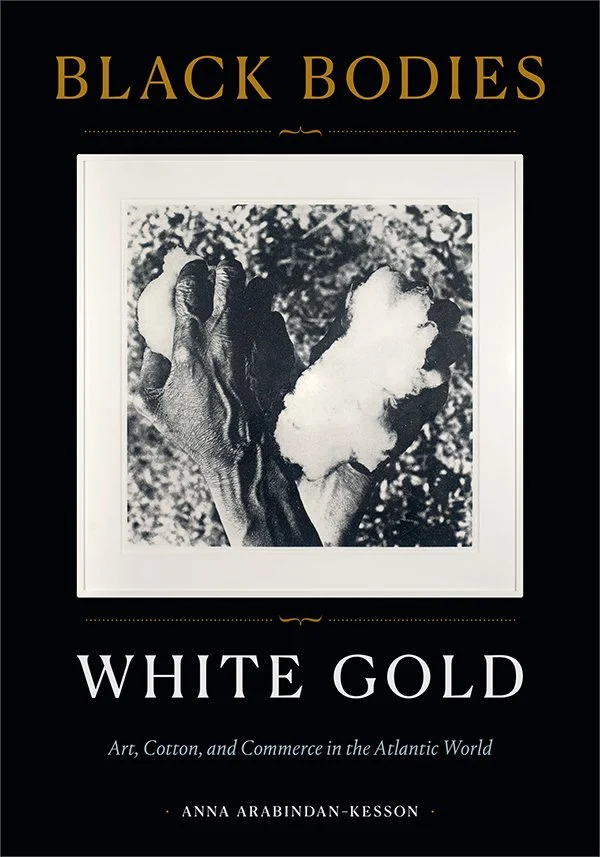
My first book, published by Duke University Press, uses cotton, a commodity central to the slave trade and colonialism, as a focus for new interpretations of the way art, commerce, and colonialism were intertwined in the nineteenth-century Atlantic world.
Winner of the Historians of British Art (HBA) award for a single-authored book with a subject between 1800–1960.
From the HBA: “Arabindan-Kesson’s book investigates what at first seems obvious: the equivalence of black bodies and white cotton produced by slavery and the networks of racial capitalism. But Black Bodies, White Gold’s exploration of this equation, as played out on material and visual as well as economic registers, is a richly layered, nuanced, and illuminating account of not only reification and exploitation but also challenges to this logic through self-fashioning, haptic intimacies, and transatlantic solidarities. Contemporary artworks centering cotton and its histories by Lubaina Himid, Yinka Shonibare, and Hank Willis Thomas frame and anchor the discussion, which loops back to them repeatedly on its journey from the 18th century onward and around the Atlantic. Primarily grounded in a 19th-century archive that includes “negro cloth” and chintz as well as paintings, prints, and texts, Arabindan-Kesson’s book demonstrates the endurance post-slavery of what she terms a speculative vision that sees the natural world and black lives as raw materials, through a lens of profit. Beautifully written and theorised, it offers a model of art history that traverses national boundaries to unfold a legacy of visual commodification while opening up glimpses of alternatives.
Shortlisted:
R. L. Shep Award, presented by the Textile Society of America
James A Porter Book Award in African American Art History
You can listen to a podcast about the book here
You can download the introduction purchase my book through Duke University Press here
You can read a review of my book here